Not Just Funding: How Structured Challenge Drives Engineering Biology Forward
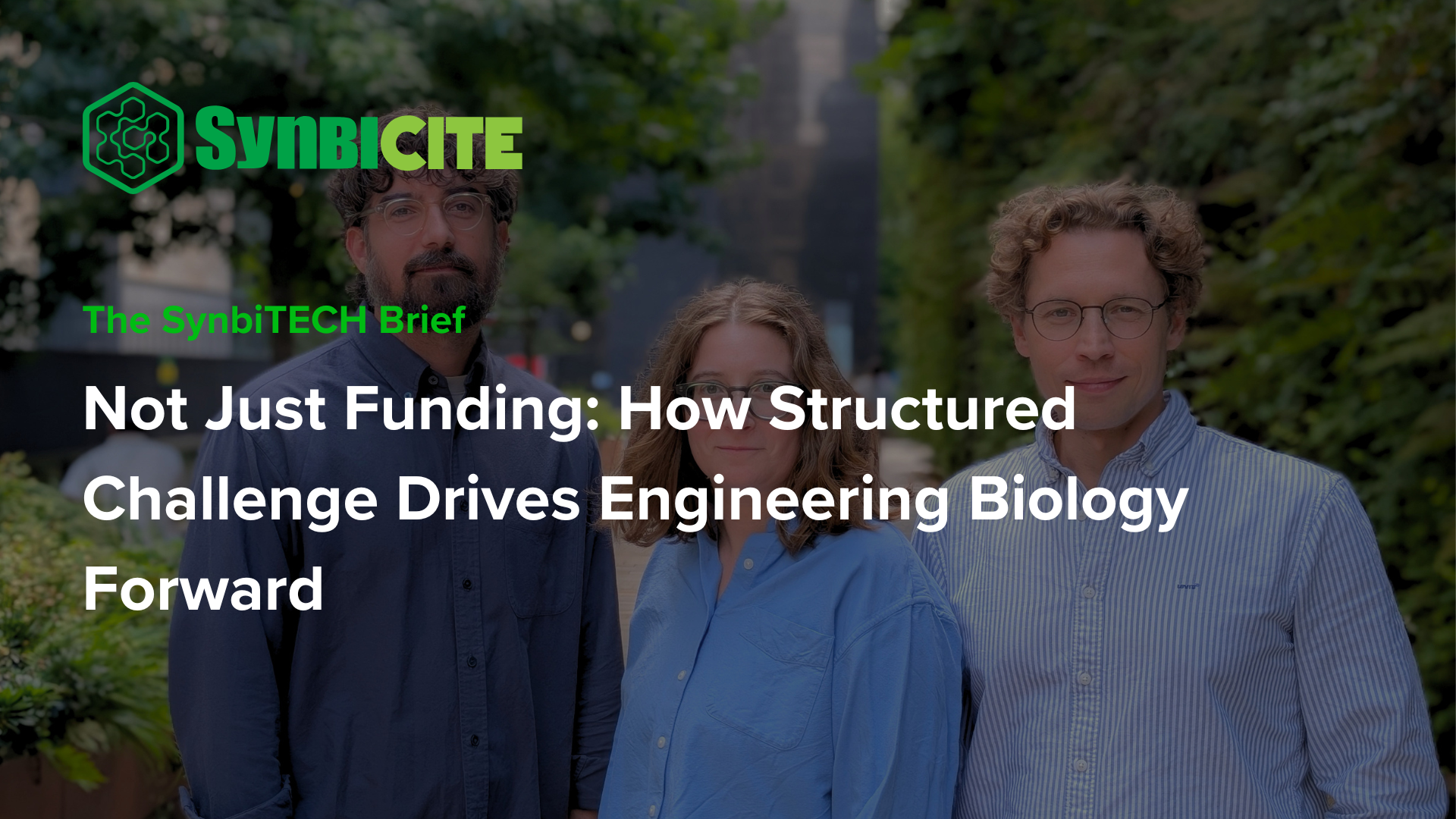
An Interview with Salpie Nowinski, co-founder of Hijack Bio
For many engineering biology companies, the path from a promising technical idea to a viable product is shaped by questions that sit outside the lab. Manufacturing, regulation, customer need, route to market and access begin to matter long before a product is ready for use.
Hijack Bio joined SynbiCITE’s Proof of Concept programme at exactly that point of transition. The company had secured its first VC investment, moved into lab space and hired its first synthetic biology research scientist. The science and the company needed to develop in parallel.

Founded by Salpie Nowinski, alongside co-founders Maximilian Mossner and Gabriel Nowinski, Hijack Bio brings together bioinformatics, wet lab and clinical experience. In a field where technical, clinical and commercial questions quickly overlap, that mix has shaped the company from the outset, giving the team the range of perspectives needed to interrogate both the biology and its path to use.
At the centre of Hijack Bio’s work is a simple question. Why are peptide therapeutics still built around complex systems outside the body?
Many peptides and biologics are produced using engineered bacteria in bioreactors before being collected, purified, formulated and distributed. These therapies are often injectable and dependent on cold-chain logistics, while alternative oral delivery remains difficult because peptides can be broken down in the stomach and gut before reaching their therapeutic target. To compensate, higher doses may be needed to achieve the intended effect, adding inefficiency to an already complex and costly system.
That is the system Hijack Bio wants to rethink. Peptides include well-known therapies such as insulin, as well as newer products such as GLP-1s, so the delivery challenge is commercially significant as well as scientifically important. Rather than optimising each stage of the existing model, Hijack Bio is developing engineered probiotic bacteria designed to produce and release peptides in vivo.
By shifting production inside the body, the company aims to remove several layers of complexity from manufacture and delivery, opening up a different way to think about how peptide therapeutics could be developed and accessed.
This ambition to challenge the status quo brings its own complexities. Salpie described how one of Hijack’s biggest challenges right now is bringing together all of the moving parts; product development, regulatory strategy, fundraising, customer validation and route to market need to all be considered in parallel. For an engineering biology startup, these strands can influence one another early. A technical choice may affect the regulatory route. A regulatory route may affect where the first market is. A customer conversation may change what needs to be tested next.
This is where SynbiCITE’s Proof of Concept programme became valuable. It gave Hijack Bio a structured environment for working through that complexity, combining access to Imperial’s Biofoundry, grant funding designed for bioengineering, and input from people with the technical and commercial experience to challenge the company’s assumptions.
Stage gates and presentations pushed the team to explain how the company would work in practice, not just how the science worked. Scientific, engineering and commercial experts asked detailed questions that surfaced assumptions early and sharpened the team’s thinking on company direction, competitive positioning and go-to-market strategy.
Customer discovery became one of the clearest lessons reinforced by the programme. Hijack Bio had already begun customer validation and engaged pharma advisors early, but the programme helped position that work as a core part of company development rather than a separate commercial exercise.
“You can’t just develop products or make things in the dark, and then hope that once you complete it, that someone’s going to want it,” Salpie said.
That comment captures a practical issue for engineering biology companies. Founders often have to test whether a technical idea can work while also testing whether it answers a real need for customers, partners, investors or end users.
Hijack Bio’s route to market has developed alongside the company’s growth. From early on, the company chose to focus on the US as its first market, reflecting regulatory considerations, market size and the relative speed at which it enables progress towards human data.
For other early-stage companies, the lesson is clear: regulatory and commercial realities feed back into development from the outset. Decisions about geography, product category, evidence generation and customer engagement are not separate from the scientific plan. They need to shape what gets built, how it is tested and what evidence is needed next.
These decisions reflect a broader shift across engineering biology. The sector has moved through periods of excitement, followed by more difficult phases of translation. Salpie described the current period as a “second phase”, shaped by lessons from earlier companies and closer attention to CMC, manufacturing, commercialisation and the practicalities of getting products into use.
This is where SynbiCITE’s Proof of Concept programme plays an important role. Engineering biology companies need infrastructure and technical support, but to sustainably grow they also need informed challenge on market need, regulation and adoption. The programme brings those elements together at the point when they can make the greatest difference.
Hijack Bio’s experience shows why those questions need to enter company-building early. The technology may start in biology, but the path to impact depends on the right conversations, the right infrastructure and the right challenge at the right time. For Hijack Bio, SynbiCITE’s Proof of Concept programme helped provide exactly that.
Secure your early bird ticket for SynbiTECH
SynbiTECH is the UK’s leading international forum for people engaged in engineering biology business, investment, policymaking, science and research.
Returning for the seventh time, this major synthetic biology business conference brings together more than 400 delegates and speakers from across synthetic biology, sustainability and business innovation.
This year’s programme will explore the themes shaping the future of engineering biology, including multifaceted AI, biosecurity, industrial strategy and scale up, sustainable futures, finance and commercialisation, and policy.
Early bird tickets are available for £350 until 30 September. Secure your place and join the conversation on how engineering biology can move from breakthrough science to scalable, investable and globally relevant solutions.