Scaling Synthetic Biology: Lessons from Industry Leaders

Scaling up is the defining challenge for engineering biology today. At SynbiTECH2024, our expert panel tackled this issue head-on, drawing on their experiences to highlight the risks, opportunities and strategic actions that will shape the sector’s future.
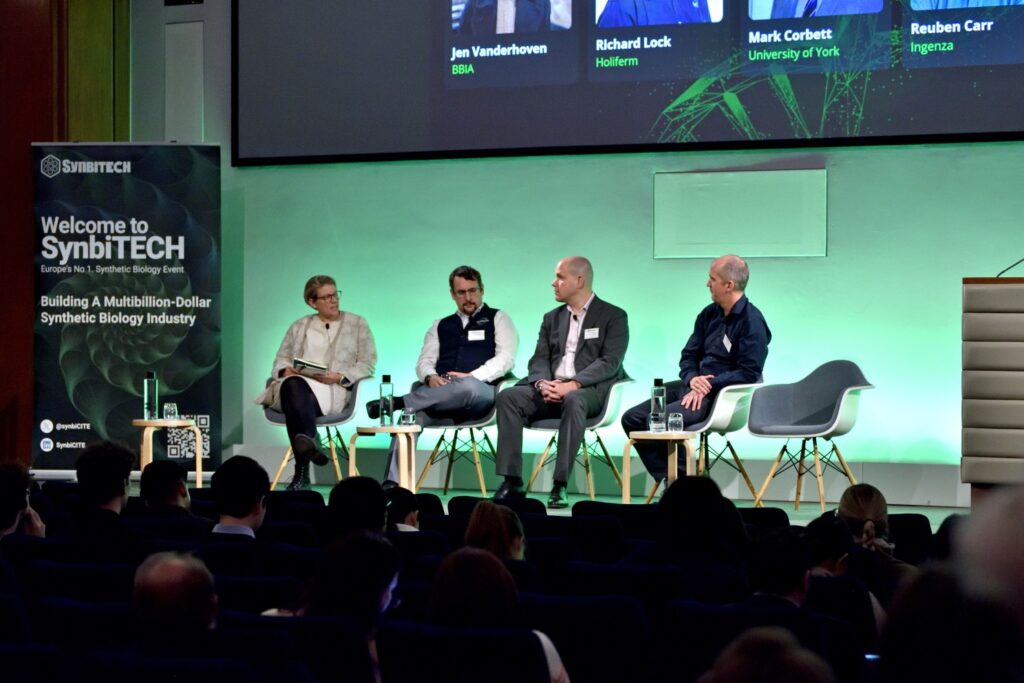
The panel brought together four experts who are driving change across industry, research, and policy:
- Dr Jen Vanderhoven, FRSC, Chief Operating Officer, BBIA
- Richard L. , COO & Managing Director, Holiferm
- Mark Corbett , Director, Biorenewables Development Centre
- Reuben Carr , Head of Chemical Biology, Ingenza Ltd
Taking Risks and Learning from Failure
The panel agreed that scaling innovation requires both agility and a tolerance of failure. “You need to be able to take more of a risk early on; fail quickly but succeed in the long run,” said Richard Lock. He argued that failure is not an endpoint but a learning tool: “If you fail quickly and learn, you can then go faster.”
Mark Corbett, whose team has supported more than 1,700 projects with 650 organisations, reinforced this point. He described early failure as often the most cost-effective route to long-term success, allowing companies to discover their limits and adapt before committing major capital. The discussion highlighted the importance of creating environments where experimentation is not penalised but encouraged, particularly for smaller firms where each investment decision carries higher stakes.
Infrastructure and Global Competitiveness
A consistent theme was the lack of infrastructure to support companies at different stages of their scale-up journey. Reuben Carr pointed to the need for modular and adaptable facilities that can grow with industry demand, citing his own experience of using fermenters designed by a nuclear engineering company that proved 80% cheaper than traditional manufacturers.
Lock stressed the importance of adopting a “two-pronged approach”: strengthening the UK’s capabilities while also working more openly with international partners. “We are only 70 million people; we can’t compete as the go-to nation on our own,” he said, urging a balance between national strength and global collaboration.
Corbett was optimistic about the UK’s trajectory, highlighting its rising position within a modern industrial strategy. With more distributed infrastructure and smarter funding aligned to company stage, he argued, the UK could seize the opportunity to lead in industrial biotechnology.
Policy, Regulation and Capital
Regulation emerged as a critical enabler. Jen Vanderhoven described the challenge of navigating 56 different government departments from concept to commercialisation, noting the progress made with the creation of the new Regulatory Innovation Office but emphasising that more needs to be done. She argued for bold, catalytic policies, such as mandating that 5% of jet fuel be produced sustainably, a move that could instantly spark new industries and accelerate growth.
Richard Lock added that the regulatory system could be transformed by assigning clear accountability. “Put one person in charge of chemicals going commercial and make them responsible,” he suggested, pointing to the need for decisive governance rather than fragmented oversight.
Capital was another pressure point. While larger companies often have greater resilience, panellists agreed that all organisations are ultimately accountable for capital movement, requiring alignment at board level. For smaller companies, where sensitivity to capital is highest, investors must be convinced that risks are balanced by long-term opportunities.
Winning Public Trust
Reuben Carr reminded the audience that chemicals and materials are deeply embedded in daily life. “We can’t rid ourselves of them unless we want to return to the stone age,” he noted, framing the challenge as one of perception rather than necessity. He pointed to lessons from the pandemic, when the public developed a new interest in complex processes and scientific detail. The same transparency and engagement, he argued, are needed to build support for sustainable alternatives.
The panel stressed that public communication is as important as technical innovation. As Carr put it, “We are in the middle of a crisis, and we need to get the message across that sustainable materials will save lives.” Richard Lock added that future facilities should adopt an “open-door policy” where communities can see firsthand that modern biomanufacturing does not rely on harmful chemicals and would be a powerful way to earn trust.
Looking Ahead
The discussion underscored the scale of the opportunity if the UK can align infrastructure, regulation, capital and public trust. Richard Lock projected that, under ideal conditions, synthetic biology could contribute as much as 20% of UK GDP within the next two decades. Reuben Carr added that the next decade should bring a radical shift, where society could credibly discuss turning off oil and gas and moving towards distributed, regional centres of biomanufacturing and creating value well beyond London and the South East.
The panellists agreed that this vision is within reach, but only if industry and government act decisively now.
At SynbiTECH2025, we will build on these insights by convening global leaders across science, industry, investment and policy. Together, we will explore how capital, regulation, partnerships and platforms can accelerate the industrialisation of biology that will unlock new markets, drive sustainable growth, and shape a resilient future economy.