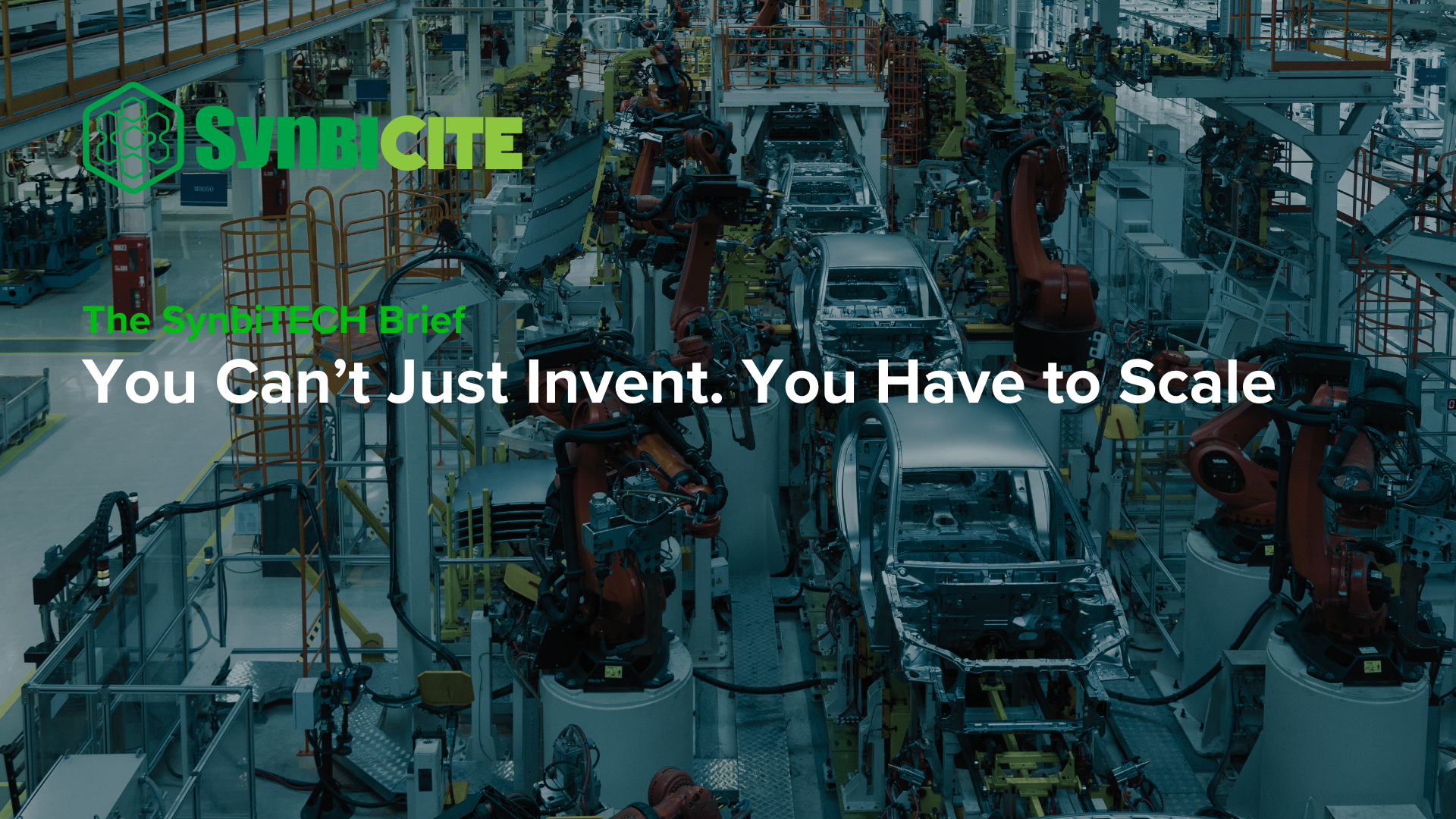
“You Can’t Just Invent. You Have to Scale” – Why Engineering Biology Must Embrace Manufacturing Innovation
Synthetic biology is at a pivotal stage. The science is maturing, the applications are expanding, and investment is growing. Yet one stubborn obstacle remains: scale. Without the ability to manufacture at volume, even the most innovative ideas fail to make an impact.
In this CEO Spotlight, Adam Glen PhD , CEO of Unicorn Biotechnologies and speaker at SynbiTECH2024, shares his perspective on why manufacturing must become a core focus within synthetic biology. With a career spanning academic research, industrial development, and company building, Adam brings a rare clarity to the challenges facing the field today.
“The motivation behind Unicorn comes from years of pain more than anything,” Adam says. “It’s scratching my own itch but also seeing the same issues come up again and again across R&D and manufacturing and wondering why the solutions are not good enough.”
That pain point, he explains, centres around the complexity of culturing cells at scale. Having worked with cell culture for nearly two decades, first during his PhD and later in industry, Adam saw how time-consuming, variable and costly the process could be. “How do you do your R&D faster, cheaper, quicker? And it’s the same with manufacturing,” he noted. Whether in academic labs or commercial facilities, reproducibility was a constant challenge. Not only were the cells a variable, but the people handling them introduced inconsistencies as well. These frustrations became the foundation for Unicorn, which emerged from a shared ambition with his co-founder to do something more effective. “I did a little work prior to that myself, mainly tinkering,” he reflected. “But building and running companies is not for the faint-hearted. Everyone needs some assistance on this.”
The Real Barrier to SynBio Success? Scale
Many companies in synthetic biology are built around brilliant, small-scale innovations. Yet Adam believes this model only takes us so far. The real challenge is not invention, but the transition from lab prototype to large-scale production.
“What R&D scientists call innovation is actually what I call invention. They do something clever on a small scale, publish a fancy paper, and then move on. But the real question is, how do you get that to mass scale?”
The problem is systemic. As a field, synthetic biology has celebrated novelty and discovery, but too often overlooked what it takes to manufacture a solution at commercial volumes. Adam argues that unless this mindset shifts, the sector will continue to stall at the proof-of-concept stage.
“There is that quote, isn’t there, about the last ten percent being the hardest ten percent. That’s where most of the failure happens.”
Without scalable production, even the most promising bio-based technologies struggle to gain traction. For Adam, scale is not a secondary consideration; it is the decisive factor in whether or not synthetic biology can deliver real-world impact.
The Missing Middle: From University to Industry
Adam identifies a critical gap in the current innovation pipeline. Research institutions are producing exceptional science, and major manufacturers are equipped to produce at volume. Yet the space between these two worlds is often underdeveloped or ignored.
“We have excellent universities and large manufacturers that do things in the way they know how. But there’s this big chasm in the middle. Often, we try to shoehorn an R&D approach into a manufacturing context, and it just doesn’t work.”
The issue is not just technical, but structural. Researchers are incentivised to publish novel findings, while manufacturers are focused on efficiency and compliance. Neither is fully incentivised to build new, scalable platforms. Adam believes this middle ground is precisely where new ventures must emerge.
“You want to try and influence people in university… to take it all the way through to commercialisation.”
Bridging this divide requires a new kind of organisation: one that combines the rigour of science with the discipline of product development. For Adam, companies like Unicorn can fill this space, translating promising research into production-ready solutions.
Manufacturing is Not a Dirty Word
Another cultural shift is needed within the synthetic biology ecosystem: a reappraisal of what it means to work in manufacturing. Too often, manufacturing is treated as an afterthought or a service layer, rather than a space where real innovation takes place. Adam believes the perception that manufacturing is not very exciting has limited how scientists, especially in academia, view their role in taking research forward. There is often an assumption that once the discovery is made, the responsibility for scale and implementation lies with someone else. But this disconnect, he argues, prevents meaningful impact.
For Adam, the problem is not that manufacturing lacks creativity, but that the ecosystem has failed to value it in the same way as early-stage discovery. He challenges the notion that innovation ends with a publication, arguing instead that some of the most important advances happen when people try to make things work at scale.
“You don’t necessarily need to just keep inventing new things for the sake of inventing new things. You want to take it all the way through to commercialisation.”
He also highlights a wider cultural issue, particularly in how universities train and reward scientific talent. Academic incentives are structured around novelty and peer recognition, not necessarily around the long-term utility or usability of a discovery.
“There’s a quote I really like from Charlie Munger: ‘Show me the incentive, and I’ll show you the outcome.’ In academia, the incentive is to publish novel research, which they do, and then do it again and again. But how do we make a thing that benefits humanity?”
He sees part of the solution is to bring attention to manufacturing as a legitimate and rewarding space for innovation, especially for students and researchers considering where to take their careers. The complexity involved in developing scalable systems is no less intellectually demanding than molecular design; it is simply undervalued.
Integration is the competitive edge
At the heart of Unicorn’s approach is an integrated, interdisciplinary mindset. Their greatest scientific and technical challenges arise not from individual fields, but from how those fields interact. Many companies treat biology and engineering as separate domains, outsourcing one or the other. Unicorn keeps both in-house, which enables them to iterate more quickly and avoid costly disconnects between components. The company is building devices where biology and hardware co-evolve. It is not just about running cells through a machine but designing the machine to work with biological systems in real time. That level of integration, while technically demanding, is what gives Unicorn its edge, but it also depends on human capability. One of the company’s most important decisions has been how it builds and maintains its team.
“The one thing we’ve been really good at is hiring the best people. We do it all ourselves.”
Team culture is about more than competence. It is about shared purpose and agility. Unicorn’s model is based on trust, autonomy, and the belief that fast learning is more valuable than following conventional paths.
A Call for a Cultural Shift in SynBio
Adam believes that the synthetic biology sector as a whole must become more comfortable with the practicalities of commercialisation. That starts with encouraging researchers to take their ideas beyond the publication stage.
“The incentive in academia is to publish novel research. But how do we make something that benefits humanity? Often that becomes someone else’s problem. But it should be yours too.”
He is not suggesting that blue-sky research should disappear. Rather, he believes the sector needs to place greater value on end-to-end innovation, where ideas are carried all the way to implementation.
This shift requires support from funders, universities, policy makers and industry. It also requires events like SynbiTECH to shine a light on the work happening between discovery and deployment.
“The UK is a relatively small island. But we have some of the highest densities of scientific and engineering talent in the world. We publish loads of research but we do not commercialise most of it.”
Adam’s perspective is clear. The tools are here. The science is here. What is needed now is the infrastructure, the incentives and the leadership to turn invention into transformation.
As SynbiTECH2025 approaches, we’ll continue spotlighting the ideas and individuals shaping the future of engineering biology. Stay with us as we track the breakthroughs, the business models, and the bold thinking pushing the industry forward.