Democratising Biology Begins with Creating Space for New Innovators
Democratising biology begins with making space for people willing to take risks. The growth of the life sciences depends on innovators who are prepared to build something new, often without knowing that it will work. But that kind of innovation takes more than research excellence, funding, or policy. It depends on infrastructure, practical support, and environments that help people see themselves as innovators in the first place.

For Bethan Wolfenden , co‑founder of Bento Bio, that journey began during her undergraduate degree, when she took part in iGEM and met her future co-founder Philipp Boeing. What stood out from the experience was not the competition alone, but the autonomy it offered. As a student, she was encouraged to propose ideas, develop her own project, and be taken seriously by experienced scientists. That sense of permission mattered. It showed her that innovating was not reserved for people with established labs or senior titles, but something she could actively contribute to. It also connected her to a wider network within London’s synthetic biology community, where early‑stage researchers, founders, and established figures interacted as peers.
In 2016, Bento Bio took part in SynbiCITE’s LEAP programme. At that stage, the company was still under‑resourced and finding its identity, so the support they received was practical rather than abstract. Access to shared laboratory space removed an immediate barrier the founders would otherwise have faced. The availability of professional equipment and consumables, including discounted materials, made experimentation financially viable. Support from SynbiCITE’s lab managers provided day‑to‑day guidance that went beyond simply accessing the space. Being part of SynbiCITE also conferred credibility, helping a team in its very early stages be taken seriously within the London synthetic biology ecosystem.
Those elements reflected a broader belief that innovation accelerates when more people are supported early. For Bento Bio, that practical support created the conditions needed to test ideas rather than just hold onto them. Over time, those experiences shaped a mission that continues to define the company: making biology more accessible, useful, and inclusive for the people who want to work with it.
How the Vision Evolved: From Enthusiasts to Enablers
In the early days, Bethan and her co‑founder were driven by their enthusiasm for synthetic biology. They shared a hopeful assumption that if the tools were available, people would naturally want to use them. But that initial assumption proved limited. A community of enthusiasts alone was not a sustainable market. Through early experiments and feedback, they began to see that most users cared less about the biological method and more about whether a tool could help them solve a real problem. That realisation marked a turning point. Democratisation, they came to understand, was not just about giving people access to a technique, but about delivering genuine value in contexts that matter to people.
Enter SynbiCITE: support and infrastructure
SynbiCITE, among other programmes and opportunities, played an important role in supporting that transition. Beyond providing physical infrastructure, the accelerator experience reshaped how the founders approached building a company. Through the Lean LaunchPad, they were encouraged to speak regularly with users, often having more than ten conversations a week. Those discussions pivoted their focus to product‑first thinking towards understanding the problems people were actually trying to solve. Assumptions were challenged through evidence, iteration, and repeated testing and feedback.
That mindset has endured. The Lean LaunchPad introduced an approach closely aligned with the Toyota Kata method: setting clear goals, taking small steps, forming testable hypotheses, and learning continuously from results. Listening carefully to users from very different domains helped Bento Bio recognise the breadth of its potential impact. It also embedded a culture of curiosity, openness, and iteration that remains part of how the company operates today.
The wider SynbiCITE network reinforced those values. It brought together a diverse synthetic biology community where early-stage founders could interact directly with experienced practitioners and senior leaders. Mentors, collaborators, and industry figures were accessible and open to engaging with new ideas. Trade missions, talks, and international opportunities broadened horizons at a formative stage. Perhaps most importantly, being taken seriously early on helped challenge the idea that credibility must always be earned through seniority alone.
Today, the influence of that support is still visible in how Bento Bio operates. Lean LaunchPad thinking and Toyota Kata principles continue to guide decision‑making. User insight, rapid iteration, and evidence‑based choices remain central. The commitment to democratisation runs through both product design and company culture.

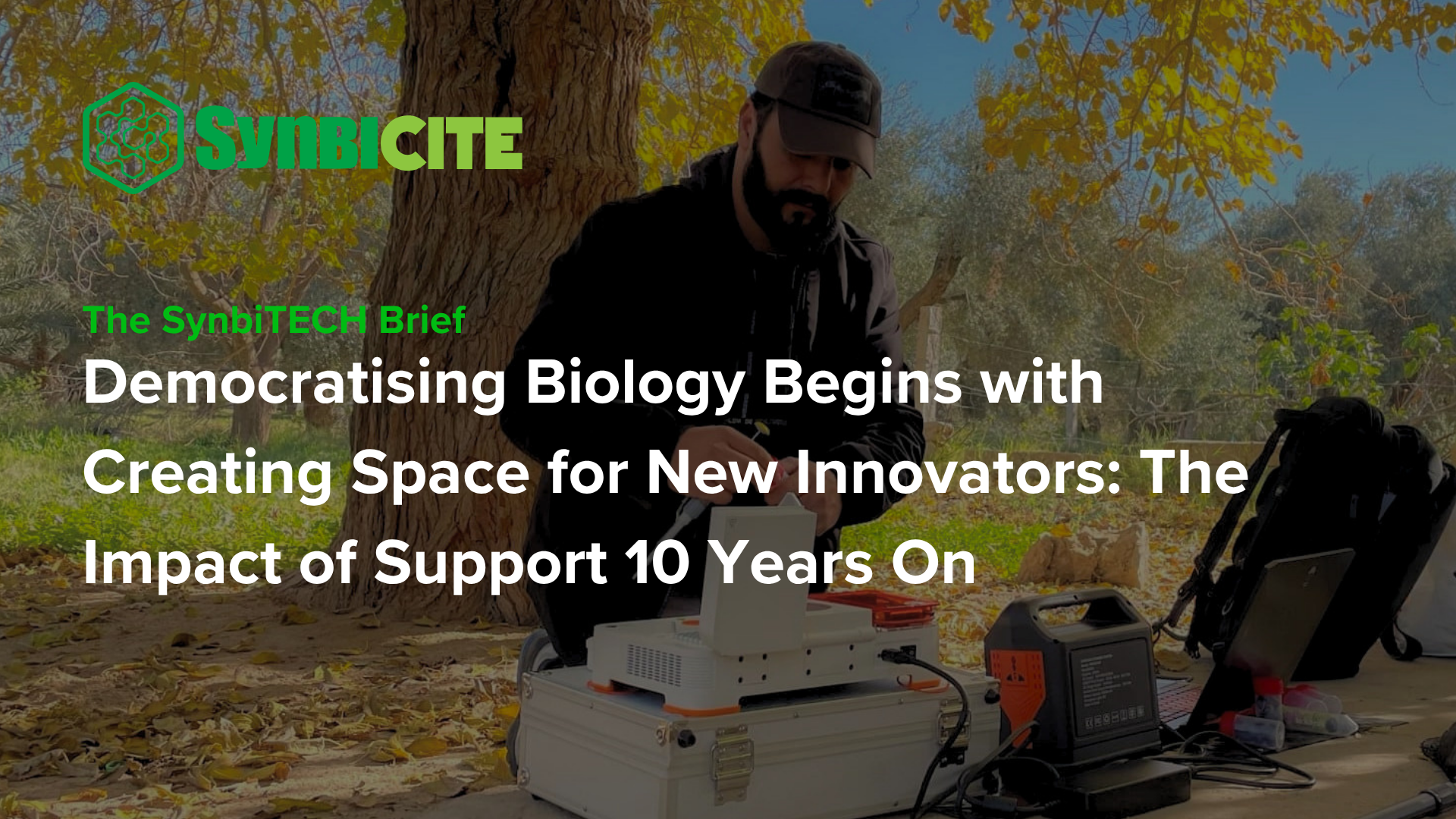
Bento Bio’s core mission is to make molecular biology tools useful, portable, and accessible. Its customers span diagnostics, global health, wildlife conservation, education, and citizen science. For those users, what matters is not PCR as a technique, but the insight it provides, the speed of results, and the ability to act on site. Malaria surveillance teams can validate samples in the field instead of waiting months for analysis. Virologists can sample live-animal markets to catch emerging pandemic threats like bird flu before they spill over. Conservationists can identify endangered species before leaving remote locations. High‑school students in Berlin study local bee populations, while retired mycologists teach themselves molecular biology to support underfunded biodiversity research. In each case, participation extends far beyond traditional laboratory settings.

When biology becomes accessible in practical ways, its impact multiplies. Democratisation does not happen through ideas alone, but through access to the space, tools, guidance, and credibility at the moments when they matter most. The growth of the bioeconomy depends on early‑stage innovators being able to test, learn, and build before they are fully resourced or proven. By lowering structural barriers and investing in shared infrastructure and founder‑focused support, programmes like SynbiCITE help turn curiosity into capability and potential into practice. Over time, that creates not just individual companies, but a stronger, more diverse ecosystem where biology can be applied, adapted, and advanced by many more people.
Make sure you don’t miss your opportunity to join us at SynbiTECH2026. Super Early Bird Tickets are available until June 30